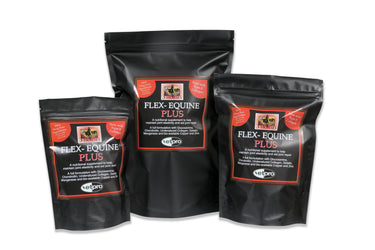
VetPro 3 Horses FlexEquine Plus - 500grm

$90.99 NZD
Tax included. Shipping calculated at checkout.

3 Horses Flex-Equine Plus is a nutritional (100% natural) supplement formulated for feeding to horses with impaired joint function. It helps to maintain cartilage elasticity and aids in the repair of damaged cartilage. It is an improved development of Flex Equine as it also contains Undenatured Collagen Type ll, which has been scientifically proven to increase the already established benefits of our formula with Glucosamine, mixed Glycosaminoglycans (Chondroitin), Manganese Ascorbate, Copper Chelate, Zinc Chelate and Gelatin.

Soreness related to joints can develop from trauma, direct or from the concussive effects of the legs striking on hard surfaces, or from age i.e. degenerative loss of cartilage quality. The resulting osteoarthritis is similar in humans and horses. Joint pain can affect horses of all ages as confirmation defects, work on hard or uneven surfaces can be detrimental at any age. While anti-inflammatory drugs can relieve pain and reduce inflammation, it has been scientifically proven that drug free Nutriceuticals containing key ingredients at the right levels can in fact assist cartilage quality and so help relieve the prevalent condition.

Glucosamine is the major structural component of the principle Glycosaminoglycan (GAG) in cartilage. It is the GAGs that maintain the high water content of cartilage and hence its ability to resist the compressive forces during weight bearing. When the joints need more Glucosamine, as suggestive age or working damage, resulting finally in degenerative joint disease, the body is unable to speed up production because it is set at a fixed rate, therefore a supplementary form of Glucosamine is beneficial. Scientific studies have shown that 10-12,000 mg daily is required for effective repair, and that the body is able to absorb the Glucosamine and use it directly in the joints to repair and maintain the cartilage.

The mixed Glycosaminoglycans (GAGS) include Chondroitin Sulphate and Keratin Sulphate. Both these are used in the cartilage repair process. The Manganese Ascorbate is necessary for the conversion of the Glucosamine to GAGs to occur. Note Glucosamine alone is not effective - it needs to be in a formulation that ensures the required dose is not absorbed by the liver, but reaches the cartilage. Science has also shown that the combination of Glucosamine and Chondroitin provides a more effective response than either actives alone.

 Undenatured Collagen Type ll is a new discovery that was determined to be effective in relieving osteoarthritis in humans but has now been independently scientifically tested on horses and showed remarkable positive responses. Flex Equine Plus contains 555mg – higher than the 450mg shown to be effective in the science trials.

 Copper and Zinc are important trace elements that are essential for cartilage repair and maintenance. 3 Horses Flex-Equine Plus uses these minerals in the latest chelated form (glycinated) which means they are absorbed quickly and efficiently from the gut.

The gelatin in the formula includes high levels of Glycine and Proline, both of which are important components of collagen, the protein found in the cartilage matrix and again science has shown that gelatin improves the homeostasis of those amino acids required for cartilage synthesis.

 Flex Equine Plus contains the recommended amounts of the actives to be effective in improving joint elasticity and joint repairs. It puts the spring back into the horse and can assist to prolong the competitive life of the horse.

Afterpay
American Express
Apple Pay
Google Pay
Mastercard
PayPal
Shop Pay
Union Pay
Visa

Product information

Where do you deliver?

We do a home delivery run up north every Wednesday afternoon, to Langs Beach, Waipu, Ruakaka, One Tree Point. It is free to have home delivery in this area. 

We also deliver to homes in Mangawhai on request, but we would prefer if you pick up in store at 8/41 Moir Street Mangawhai.

We no longer provide a home delivery service to locations that are west of State Highway 1. However, we do provide a roadside pick up service for Maungaturoto and Paparoa on request. 

If you have a special request, please phone Steve on 027 292 4891 or email kim@bobandben.co.nz.

Do you deliver to rural addresses?

Yes we do! We live rural just like you and we know how frustrating it is when rural addresses are excluded from home delivery.

Can I order petfood if I live outside your delivery area?

Yes you can. We offer roadside pick up in Maungaturoto and Paparoa on request, and we might be able to provide roadside pick up in other locations by mutual agreement. Email kim@bobandben.co.nz or phone Steve 027 292 4891.

We also provide nationwide COURIER for a fixed fee. We can courier any products, except frozen goods.

Who are Bob & Ben?

Bob is a food-obsessed chocolate Labrador who you may meet when he is out and about doing deliveries. Ben is our security attack cat who tries to keep Bob from eating all the petfood in the warehouse!

Who owns the shop?

The business is owned by Kaipara locals, Steve and Kim Pinkerton. We live on a rural property with a collection of well-fed animals, near Kaiwaka.

Email us at: steve@bobandben.co.nz or kim@bobandben.co.nz
Phone us at: Steve 027 292 4891 or Kim 027 292 8252.

Delivery Options

Free Home Delivery: We do a weekly home delivery run from our Mangawhai shop up to Waipu, Langs Beach, Ruakaka and One Tree Point - every Wednesday afternoon.

Free Roadside Pick Up: We do a weekly roadside pick up service in Maungaturoto (midday) and Paparoa (1pm) - every Thursday afternoon.

Home Delivery: Other locations on request. We regularly deliver to Wellsford / Tomarata / Kaiwaka / Oneriri / Oruawharo.

Do you deliver to rural addresses? Yes we do! We live rural just like you and we know how frustrating it is when rural addresses are excluded from home delivery.

Click & Collect: Order online and select ''pick up'' at our Mangawhai Village store to be sure the goods you want will be waiting for you on arrival.

Courier: We cannot courier frozen goods. We deliver nationwide by courier but this isn't quick enough to prevent things defrosting.

If you have a question about deliveries, please email steve@bobandben.co.nz or phone Steve at 027 292 4891.

Keep Frozen
Be sure to put your pet’s food straight in the freezer when you get home. Raw food has the potential to spoil, if allowed to thaw or sit at room temperature.

Fresh Bowl
Ensure that a clean bowl is used each time you serve your pet raw pet food. Do not serve raw pet food in a bowl that has not been cleaned.

Serving Sizes
Only serve your pet the amount you expect them to eat, or even a little less. You are better off providing a second helping then having leftovers.

Discard Left-Overs
Once meal time is over, discard what is left in the bowl, and once again, clean the bowl thoroughly. If left out, left-overs can quickly spoil.

Clean Utensils
Make sure that any utensils or tools that you use to serve your pet the raw food is not used to scoop or serve other pet food products. And after you have served your pet the raw pet food, wash those tools or utensils right away to avoid the build-up of pathogens that can occur if the tools is left to sit for a time before cleaning.

Wipe Surfaces
Take extra care to ensure you have a clean home. Wipe down all of your counters and surfaces with soapy water before and especially after you have served your pet it’s raw pet food.

Wash Hands
When handling your pet’s food, wash your hands thoroughly before and after.


Raw Bones Feeding Guidelines

Raw meaty bones (RMB’s) are the mainstay of a balanced raw food diet. To ensure you have the best possible experience while feeding a natural diet, follow these important safety guidelines.

Ground bone only when switching – Only feed ground bone, raw bone dust and/or bone meal for the first month of switching your pet to raw. The digestive system needs time to adjust to the new diet and it’s best to give a one month adjustment period. The pH of the GI tract will change as well as enzyme production, liver and kidney function. It’s important to offer easy to digest meals to aid in making the transition as easy and stress-free as possible.

Teach Pets How to Chew – When introducing whole bones to dogs and cats, be sure to purchase bones large enough that they cannot be swallowed whole by your pet. This is especially important for highly enthusiastic pets that are new to bones. Some pets have never had experience eating and chewing raw bones and they need to practice. You may also wish to hold the bone while your pet chews for the first few times until they get the hang of chewing. Carnivores have a natural instinct to chew bones so the learning curve should be quick and easy.

Practice Taking and Trading Bones – To avoid any possibility of developing possessive behavioural issues, practice taking bones from your pet and trading them for a second bone, treat or toy and then giving back the original bone. This ensures that your pet will understand that you will give the bone back if it is taken away or will be traded for something else they will enjoy.

Supervision – Always supervise animals when feeding whole bones.

Feed Fresh – Feed bones within 48 hours of being thawed. Never feed bones that have been left to dry out. Do not let your dog bury bones in the yard to dig up and chew on later.

Feed Raw – Feed bones thawed and straight out of the package. Never cook raw bones.

Vary Bones – Do not get stuck feeding the same bones all the time. Different bones offer different nutrients and should be rotated frequently to maintain a healthy and balanced diet.

Monitor Bone Intake – Be sure that you are not feeding too much bone in one day. You will notice your pet may have harder or crumbly stools if too much is fed. To avoid this, do not offer whole bones on days when you feed meat with ground bone. Instead, offer them on days when red meat (with no bone) is fed.

Consumable Bones vs. Non-Consumable Bones

Consumable bones are any bone that can be fully eaten by your dog or cat. These bones include chicken necks, turkey necks, lamb necks, chicken carcass, chicken wingettes, and turkey wingettes. Knuckle (joint) bones can also be consumed for the most part but sometimes include pieces of femur which should not be ingested. Consumable bones should only be given to animals that are raw fed and have been taught to chew bones. We do not recommend that whole consumable bones be given to animals until they have been on a ground raw diet for 3-4 weeks or longer. Animals that do not eat raw have a different gastro-intestinal environment compared to raw fed animals so it’s best to ease your pet into eating whole bones after a switch to raw. This is one of the best ways to avoid impaction.

Non-consumable bones such as femurs and ribs must be given only as recreation and for short periods. You must monitor your animals closely. These types of bones are not suitable for all pets so please read this whole article before deciding to feed these types of bones.